


是夢? Is it a dream?
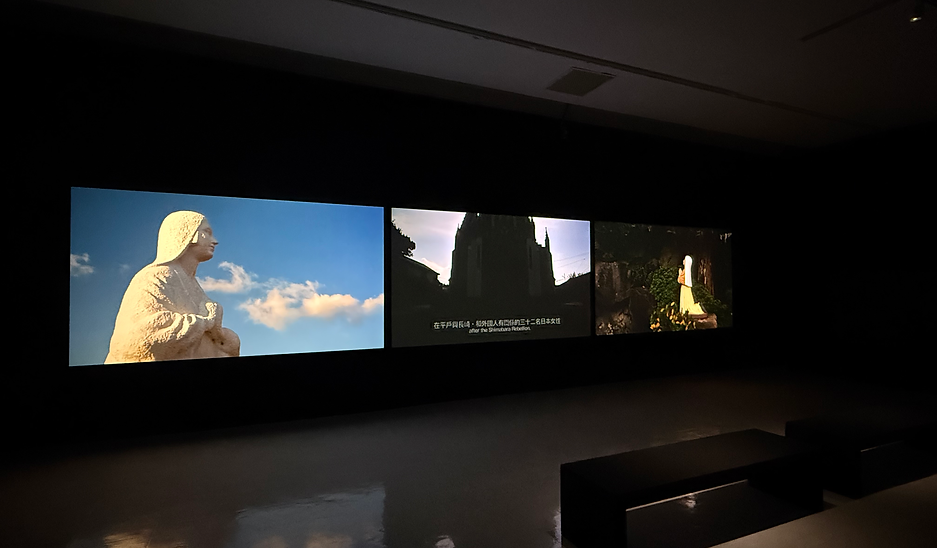
三頻道錄像。15:58。2024
《是夢?》為藝術家陳飛豪2024年日本平戶駐村成果作品,整體的敘事主軸以日治台灣浪漫主義作家西川滿轉生為平戶少女的虛構文本為引,一方面回應西川滿作品回歸台灣文學的歷史進程,另一方面試著以另一種具有浪漫主義色彩的大眾文學風情敘事與平戶地景,探索台灣與平戶間同樣具有的荷蘭文化遺產、混血性的東西方女神崇拜與鄭氏王朝傳說,而這同時也是西川滿在台時期作品中,最常引用的台灣在地元素。
日治時期日本作家的浪漫主義書寫常是當代後殖民批判的重要標的,但陳飛豪反其道而行,透過此類文本的當代書寫與重探,試著在「解殖」與日治台灣文化遺產間的中間地帶,撐出另一個帶有浪漫主義色彩的表現意圖——當陳飛豪這外來者踏上平戶的土地,以旅行者的眼光和影像凝視平戶荷蘭商館、潛伏基督徒與鄭成功廟時,關於殖民歷史、大航海時代與混血文化的叩問與探索,最終將有如那位西川滿轉世而成的平戶少女般,在各種暗示前世記憶的「夢境」指示下,走上回歸「台灣文學」的道路。
Three-channel video installation. 15 min 58 sec. 2025.
Is It a Dream? is the outcome of artist Chen Fei-Hao’s 2024 artist residency in Hirado, Japan. The work unfolds through a fictional narrative in which Nishikawa Mitsuru, a Romantic writer active in colonial Taiwan, is reincarnated as a young girl in Hirado. On the one hand, the work responds to the historical process through which Nishikawa’s writings have been reintroduced into the discourse of Taiwanese literature. On the other, it adopts a romantic and popular literary mode of storytelling, interweaving the landscapes of Hirado to explore the cultural connections shared by Taiwan and Hirado: their Dutch colonial heritage, hybrid East-West goddess worship, and the legends surrounding the Zheng dynasty. These were also among the Taiwanese motifs most frequently invoked in Nishikawa Mitsuru’s writings during the Japanese colonial period.
The Romantic writings of Japanese authors during the colonial era have often become objects of contemporary postcolonial critique. Chen Fei-Hao, however, deliberately takes an alternative approach. Through a contemporary re-reading and reinterpretation of these literary texts, he seeks to create a space between decolonial discourse and the cultural legacy of colonial Taiwan, opening up another artistic possibility informed by Romanticism.
As an outsider arriving in Hirado, Chen contemplates the former Dutch Trading Post, the Hidden Christian heritage, and the temple dedicated to Zheng Chenggong through the gaze of a traveler and filmmaker. His inquiry into colonial history, the Age of Maritime Exploration, and hybrid cultural identities ultimately follows the dreamlike guidance of the Hirado girl—Nishikawa Mitsuru’s imagined reincarnation—whose fragmented memories of a previous life lead her toward a symbolic return to Taiwanese literature.


